ak. As it was a national holiday today, the hospital was relatively quiet. Although the staff appreciated a slight break after a busy week, the children in the hospital's IDP camp were even more appreciative of the fact that they didn't have to go to school. Moi Day is celebrated in honour of former President Daniel Arap Moi who was Kenya's commander-in-chief for over 27 years, from 1975-2002.
Friday, October 10, 2008
Moi Day in Kenya
ak. As it was a national holiday today, the hospital was relatively quiet. Although the staff appreciated a slight break after a busy week, the children in the hospital's IDP camp were even more appreciative of the fact that they didn't have to go to school. Moi Day is celebrated in honour of former President Daniel Arap Moi who was Kenya's commander-in-chief for over 27 years, from 1975-2002.
Thursday, October 9, 2008
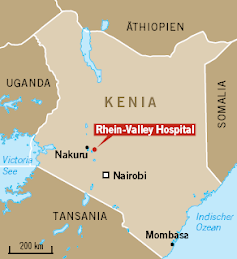
A busy day at the Rhein-Valley Hospital

ak. It was an exceptionally busy day at the Rhein-Valley Hospital today. On top of the usual 35-40 mother-infant pairs that arrived for Thursday's Neonatal Day, there was a constant flow of regular patients as well. By day's end, well over 100 patients had been attended to. Amongst the many interesting cases, there was one young girl who was terrified of a thermometer thinking it was a large needle. She protested so vehemently that Dr. Wanjara not touch her with it, Nurse Kennedy was forced to let her out of the room so she could run outside to "safety". Poor Wanjara was left in shock, not quite sure what he had done wrong.
Wednesday, October 8, 2008
Meeting Kamau the Street Boy
 ak. On the way home from the hospital this afternoon, we ran into Kamau, an orphaned boy who lives on the streets. There are hundreds, if not thousands such children in Nakuru alone. They have no official support network and for most, the only family they will ever know are the fellow children with whom they wander the streets. Although these children normally congregate in small or large groups, Kamau seems to be alone, often spotted walking along the Nakuru highway in his over-sized suit, searching for food.
 (Click on the picture to see it in large size as it appears on our photoblog "Kenya-Photos")
Tuesday, October 7, 2008
Maintenance Day
 ak. Following yesterday's rearranging day, today was spent repairing and repainting furniture and equipment. The well-used maternity ward required some of Mama Matata's attention when it was discovered a lever on the delivery bed wasn't working properly. Wakomo, one of the hospital's maintenance crew, observed attentively as the resident hospital handy-woman took care of the job. In the meantime, I showed the kids from the IDP camp how to walk on your hands, a most useful skill when working at a hospital.
 Monday, October 6, 2008
House Cleaning
 ak. After a busy morning at the hospital, we took advantage of a quiet afternoon to reorganize one of the containers and a large storage room. What started as a small task quickly escalated and eventually required over three hours of work from most of the hospital staff and members of the IDP camp. When we were done, one storage room had been cleared, a different one had been filled, and an entire shipping container used to store food had been rearranged.
Sunday, October 5, 2008
Rainy Sunday
 ak. It was an unusually rainy day in Nakuru, which meant we were unable to traverse the muddy road to the hospital. As Sundays are normally a quiet day at the RVH anyway, there is little news to report other than that we hope the sun will come back tomorrow. In the mean time, please enjoy this beautiful rainbow that was captured in Lake Nakuru National Park last week.
Saturday, October 4, 2008
Budget Transporation
 ak. It was a routine, rather uneventful day at the hospital, so the afternoon was spent buying supplies in Nakuru. En route, this family was spotted. At quick glance, they seemed rather comfortable. Who needs a station-wagon or minivan when you have a motorcycle? I'm not familiar with Kenyan road laws, but since 3+ passengers on one motorcycle is a relatively common sight, one must wonder whether motorcycle passenger limit laws even exist or if they're simply weakly enforced. Either way, with soaring fuel costs, perhaps the motorcycle is the station-wagon or minivan of the future!
Friday, October 3, 2008
The Rhein-Valley Fitness Centre
 ak. Welcome to the Rhein-Valley Fitness Centre. Here we have a full-purpose outdoor fitness complex that features a running track (two-acre lawn); a stepping machine (the road to Thugunui); a weight room; outdoor bathrooms; drinking water; fresh air; and music courtesy of the neighbouring primary school's gospel choir. Founded and built by 21-year-old Josphat Omwemga (photo), it has flourished and now has over 10 members! Josphat is an IDP that came to the hospital in January following the post-election conflicts. He now lives and works at the RVH, and is a multi-purpose employee: he cooks for the IDPs; works in the garden; and conducts general maintenance. He also occassionally moonlights as a personal trainer.
Thursday, October 2, 2008
Tricky Driving in the Rain
 ak. It was another busy day at the hospital. As usual, Thursday is neonatal day, which means the waiting room is spilling over with mothers and newborns by early morning. When all the neonatals had been processed, several other patients remained, so the medical staff was on the go without a significant break until early evening. By then, the rain had begun to fall, which makes it very difficult to traverse the lower part of the road leading to Kasambara. Thanks to a proper all-terrain vehicle (Land Rover), a skilled Swiss driver (Ruth Schäfer), and a charming Canadian navigator (Alex Keller), we made it down in one piece!
Wednesday, October 1, 2008
Collecting School Furniture


 ak. It was a busy day at the hospital today. The waiting room was full by early morning and the medical staff were on the run until mid-afternoon when there was a much-needed lull in patients. Later in the afternoon, students from the neighbouring Kasambara Primary School arrived to collect their tables and chairs, donated by the Swiss organization Kids-to-Kids. It took two trips with 20 students, but within 30 minutes the furniture had disappeared, destined for good use by rural Kenyan school children.
Tuesday, September 30, 2008
Staff Vaccinations
 ak. As Tuesdays tend to be a bit quieter at the hospital, it was decided that today the staff would receive their immunizations against Hepititis B. One would think that a hospital staff, especially its medical staff, would be immune to the fear of needles. However, Nurse Kennedy, who some days immunizes hundreds of patients himself, could barely contain a shriek as the needle was inserted. He was not alone in fear...several of the staff grimaced in 'severe pain' when receiving their injections!
Monday, September 29, 2008
A routine trip to Thugunui
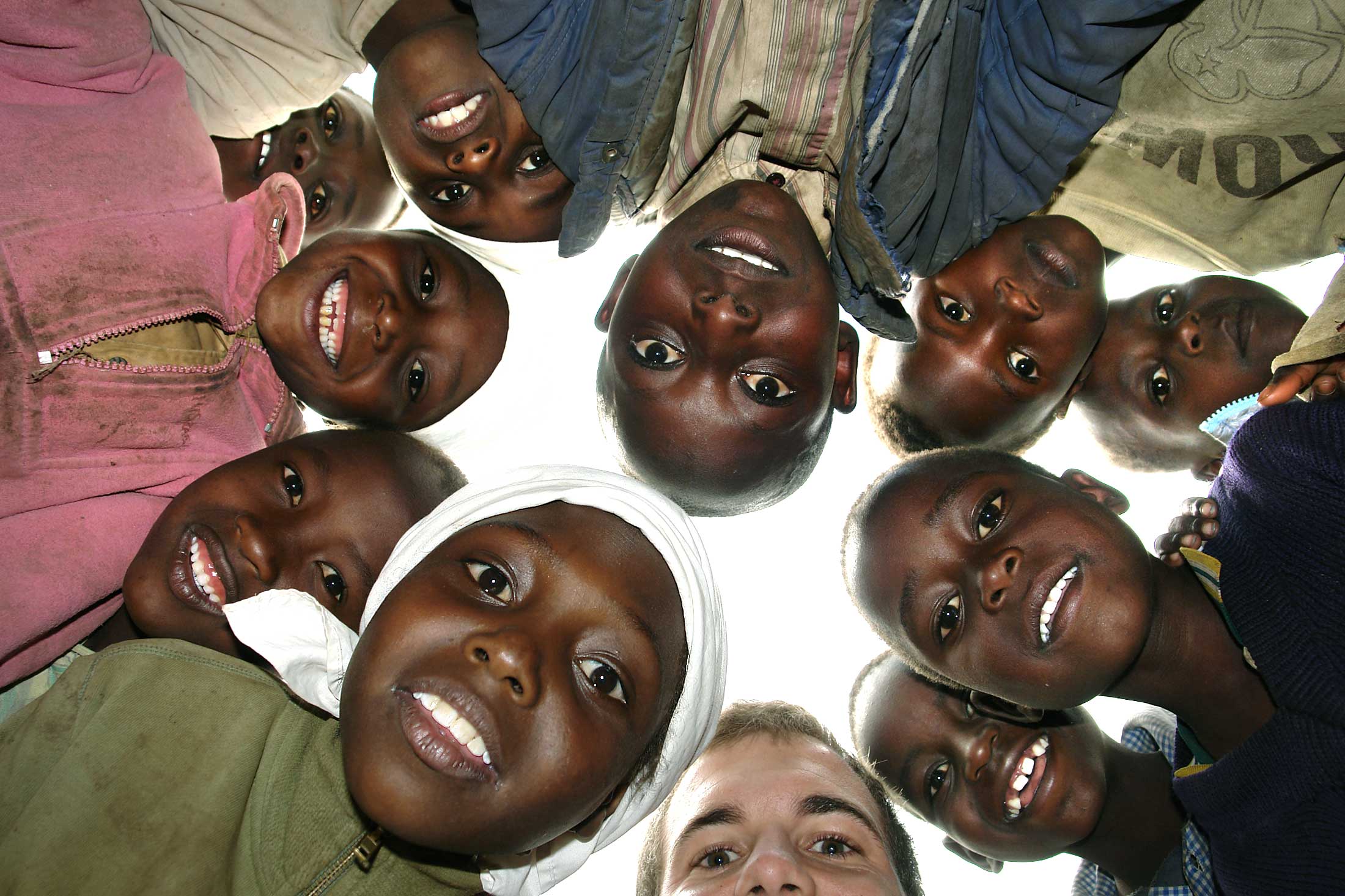 ak. After a hectic morning at the hospital, we made a routine trip to Thugunui, approximately 30 minutes by car up the mountain, to check up on the water station. Thugunui's water station was completed last year at this time, a joint venture between the RVH and Austrian NGO Schilling for Schilling. As always, the villagers welcomed us with open arms and the school children flocked to my flashing camera for a chance to see a photo of themselves. Inhabited by over 30,000 people spread across a distance of 25km, the greater region of Thugunui is nestled into a quaint valley atop a mountain range bordering the Rift Valley and Central provinces of Kenya. Isolated from electricity or running water, it has an old-fashioned, nostalgic charm about it, especially when compared to the hustle and bustle of Nakuru.
 Click on the photos to watch them in larger size!
Sunday, September 28, 2008
Sticks & Stones
 ak. On our way to the hospital this morning, we came across a large group of women gathering and carrying wood. According to Ruth Schäfer, many of these women are IDPs (internally displaced persons) who sometimes walk several kilometers just to find wood, which they use for heating and cooking. In this case, the land on which we saw these women gathering wood was private, so not only did they endure physical hardship, they also risked imprisonment if caught. In Kenya, due to mass deforestation, cutting down trees or using wood for personal purposes without a license is illegal and can result in severe fines or long terms of imprisonment. Another unfortunate example of Kenya's IDP plight.
Saturday, September 27, 2008
The Miracle of Birth
 ak. A beautiful baby boy was born today at the RVH. While the rest of the hospital lazily sauntered through a quiet Saturday, inside the small maternity ward, a young mother was in painful labour for over three hours. When the baby finally released itself from the womb, it had inhaled placental fluids into its lungs and was unable to breath. The medical staff had to act quickly and resuscitate the boy who had already fallen into unconsciousness. Within 15 minutes though, the fluids had been expelled, airways cleared, and the boy was already proving he would be the next member of the Lake Nakuru Gospel Choir. Another successful day at the Rhein-Valley Hospital.
Friday, September 26, 2008
Moving Home
 ak. Today we received another stark reminder that the struggle of Kenya's internally displaced people is ongoing. This photo portrays a typical sight of an "IDP family" moving home. As IDP camps gradually close and donor support drys up, people are forced to return to former homes where potential tribal hostilities remain. Although government officials have made attempts to completely close IDP camps, there remains tens of thousands of people who cannot return home, be it for lack of safety, lack of funds, or a combination of both. Bear in mind that many of these people experienced unspeakable horrors during last year's conflict, and returning home may also be undesirable due to the possible re-emergence of painful memories.
Thursday, September 25, 2008
Neonatal Day
 ak. Thursdays at the RVH are neonatal days. Mothers and new-borns clog the waiting room and spill onto the lawn outside. Each mother-infant duo waits patiently so that the baby can be weighed and measured to monitor for possible malnutrition. Babies are also given vaccinations if needed, for which the hospital follows a standard international protocol. In Kasambara, where computers are about as common as Polar Bears, following this protocol requires careful manual record-keeping, otherwise children could be over or under-inoculated. By day's end, over 50 mother-infant duos had been seen and most will be back again next Thursday...same place, same time.
Wednesday, September 24, 2008
Celebrating Mama Matata

 ak. This morning, a group of over 30 women from Kasambara congregated at the hospital to express their thanks for the support they have received from the hospital and its director, Ruth Schäfer. Following recent misunderstandings with the local church and secondary school, the womens group wanted to ensure Ruth and the hospital's staff were aware of the community's appreciation for the hospital. As mentioned in previous blog entries, the Rhein-Valley Hospital services over 80,000 people from the Kasambara and Thugunui region, a rural area 45 minutes outside of Nakuru.
Tuesday, September 23, 2008
An Abundance of Vaccinations
 ak. Today was a busy day for vaccinations. The hospital generally has specified vaccination days each month, but sometimes patients present even when it is not a vaccination day, as several did today! Most were between the ages of 5 and 12, with some older and some younger. The most common vaccinations are those that protect children against cholera and hepatitis, diseases that were common in the Kasambara-Thugunui area until the hospital began offering its services in 2004.
Monday, September 22, 2008
Two Burn Victims...
 ak. It was a busy Monday at the Rhein-Valley Hospital. By 9:00am, the waiting room was already full and over 15 patients were waiting outside. Within one hour of each other, two completely independent pediatric burn victims arrived for emergency care. One had fallen into a fire and burned her knees. The other had tripped, while walking backwards, into a pot of boiling water. Nurse Kennedy worked diligently and efficiently, and within 45 minutes the boy was on his mother's back heading home...mind you, without a smile.
Sunday, September 21, 2008
Quiet Day at Lake Bogoria
 ak. Sundays are quiet in Kenya as most people go to church and don't work, so we made a quick day trip to Lake Bogoria National Reserve. Approximately 2.5 hours north of Nakuru is this non-fenced reserve, which is know for its famous geyzers. It is also host to a variety of wildlife, including flamingoes, ostriches, impalas, wart-hogs, hyenas and a herd of elephants that migrate over the park's surrounding mountains two or three times per year. En route, we also had several encounters with the indigenous Pokot and Tugen residents of the area, many of which still reside in traditional Kenyan huts. (Click on the picture to see it in large format)
Subscribe to:
Comments (Atom)