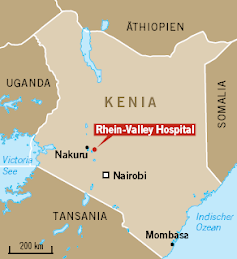
We are proud that our Blog "Rhein-Valley Hospital News" is becoming more and popular with now 10,000 viewers from many parts of the world (see map). Thanks to the regular news coverage by Ruth Schäfer, director of the Hospital we can supply this daily news to you!
Sunday, July 6, 2008
Our Blog: 10,000 views in 6 months!
We are proud that our Blog "Rhein-Valley Hospital News" is becoming more and popular with now 10,000 viewers from many parts of the world (see map). Thanks to the regular news coverage by Ruth Schäfer, director of the Hospital we can supply this daily news to you!
Saturday, July 5, 2008
Without support we cannot feed the refugees
rs. Today we had a big discussion about the food. Although the Government promised us support, we still don't know if we get enough food for the refugees in the camp. Therefore we called everybody and tried to explain the situation. If we don't get food supplies from the Government side, the refugees have to look for themselves and we can give them only fresh drinking water and shelter. Our provisions are nearly finished and we need more supplies. We agreed that a delegation of the refugees will go to the DO (District Officer) on Monday to make their case. We will give them the money for the trip to Nakuru town. Let's hope for a good response; otherways I will have to intervene myself. As PS Dr. Nyikal spoke of collaboration on Thursday, we hope for a positive outcome of the problem.
 Refugees discuss the problem of food supplies
 in front of the Rhein-Valley Hospital
Friday, July 4, 2008
Cholera protection for 5000 people
 rs. The delegation of the Government that visited us yesterday also brought us medications to protect the population against cholera. So far we could give the pills to 5000 people that should protect them for the duration of about one week. Again, there were lines of people in front of the hospital and we served them out of the window so that only ill patients had to go inside. In Kasambara the cholera situation improved a bit although we still have to be cautious. One news item was still alarming: in the General Hospital one nurse got infected after she treated cholera patients. Fortunately we were very cautious at the Rhein-Valley Hospital and reacted immediately after the first cholera cases with masks for the staff, gloves and boots.
Thursday, July 3, 2008
Government promises support in the future
 rs. Today we had the visit of several Government officials in connection with the cholera outbreak, that we realized a couple of days ago and which we also immediately reported to the Health Ministry. Among the guests were the Secretary of the Parliament Dr. James Nyikal as well as Dr. John Odondi of the Province Ministry of Health and Dr. Nyakiba, the District Minister of Health. Our two doctors Wanjara and John proudly showed them our hospital and all guests were very impressed with what they saw and with what we have done for our patients, our staff and the refugees in the camp. Dr. Nyikal thanked as many times and promised full support of the Government in the future. The above picture shows Mr. Nyikal greeting Ruth Schäfer, director of the Rhein-Valley Hospital at the end of today's meeting.
Wednesday, July 2, 2008
Cholera: 100 cases and 10 deaths
 rs. In the regions of Naivasha, Kasambara, Escharira and Nakuru the cholera has broken out. Now the Ministry of Health seems to wake up after 10 people died and 100 cases were noted. Last week we already informed the authorities about the situation but they didn't react. Today they visited our place and tomorrow more officials from the water and health department will come to discuss what has to be done. The Government always speaks of collaboration. We hope that finally we can work together and also get proper help.
 Refugees get their medications in the Rhein-Valley Hospital
Tuesday, July 1, 2008
Visiting the Nakuru Press
 rs. Early this morning I drove to the industrial district of Nakuru and went to the Nakuru Press, where all our printed patient cards are being printed. I was not allowed to take any pictures inside the building. Jakob, one of the workers helped me bringing the package to the car. Then, I realized that I have forgotten my disk with the file. I took the chance to ask if they would also produce receipt books and I gave an order of 100 pieces, to be finished next week. I was speaking with the workers ouside when suddenly the director came. He is an Indian man. The white people born here in Kenya are not so easy to understand. They have quite a different mentality. A strong resentment against the black is often to be felt.
Monday, June 30, 2008
Our big cleaning day
rs. Today we had a major cleaning day. All the mattresses were take out of the hospital and the blankets and pillows were disinfected. The toilets and washrooms were especially cleaned. Six refugee men helped us the hole day, all together we were a crew of 14 workers. After a short lunch break we continued in the afternoon and I took out my hot steam cleaner for the mattresses. At 5 pm everybody was happy that the duties were done. And when I drove home, a big rainfall started. The weather changes as quickly as some of our people change their mind...


Sunday, June 29, 2008
The first tooth

rs. This young camp habitant got his first tooth. This Sunday is quiet as usual. The refugees take their time to clean everything and to go to church. By the way there are five different churches here. Most of the refugees are happy with the life in the camp and adopted well all the rules and regulations although for many of them it is quite a challenge considering their past life in the bushes.
Saturday, June 28, 2008
Visiting the water station in Thugunui
 rs. Today I visited the water station that had been built with the help of Eddie Kroll in Thugunui. Our guard Nelson was just cleaning the house when I arrived. He informed me about a small whole in a tube that has to fixed, so I organized our sanitary person Kamau to come next week.
  Then I went to the "Hotel" of the village and saw they were preparing some local specialities. When I had my meal many school children came and asked if I brought something for them. Unfortunately I had nothing with me, perhaps next time. The teacher also appeared and said that I had some magic power; the children I recently visited finished school with high marks - much higher than the children in Kasambara. The local in Thugunui always enjoy when I come up the mountain to meet them and on the way I have to greet everybody. If not, they get mad at me! And I also keep getting offers to get some land from the locals to build my house there.
 Sunshine Hotel in Thugunui
Friday, June 27, 2008
A vist to the refugee's garden
 Mama Matata overlooking the garden
rs. The refugees are cultivating their own garden and are growing their own vegetables. Although the amount of rain is not big at the moment, the seedlings are growing well. The refugees were very proud when I visited their garden. In between the corn I found some beans and I told them that they are already ripe to pick. Besides the beans there are cabbages. The earth here is not easy to cultivate because when it is drained, it becomes heavy and cloggy. And when the earth becomes dry, it is solid like a stone. I explained how they can recycle kitchen garbage to nourish the earth. The Kenyans need some time to get convinced, but at the end we both can learn from each other!
Thursday, June 26, 2008
Concern about Infection cases

rs. Nyaga called me early this morning because five patients showed signs of serious infections due to polluted water that they drank from a river in the area of Fescha, about 10 km away from our hospital. We immediately informed the health commission. Hopefully they check the situation there to prevent a larger breakout. We always advise the people to boil the water before drinking but often they don't have the money to buy the necessary wood. We did some first tests in our laboratory and should have more details by tomorow. At the same time I bought additional material to properly disinfect our staff.
Wednesday, June 25, 2008
The control duties of our guard Askari

rs. Our guard Askari is usually at our entrance gate and is responsible for controlling all bags of the people coming in and out of the hospital ground. He also keeps track of the amount of water that is being taken. Another control duty is checking the working times of our crew and patients are marked down in a book together with the amount they payed for the treatment.

Tuesday, June 24, 2008
People should communicate more
 rs. This is the child that was born during the night. We published a picture of the mother waiting in the garden in yesterday's post. It's so fascinating to see how quickly the Kenyan mothers recover from a birth. Normally a mother stays in the hospital for a couple of days or even a week!
This morning Nyaga came to me and said that he got a call from a man who reported that his wife and the three children came to our camp and he wanted to get them out again. At 1 pm he came and we had a long and difficult discussion. First I spoke with him alone and then we invited his wife. After 4 hours we made some progress and we agreed to meet again in a couple of days. The big problem here in Kenya is the lack of communication. They didn't learn to make decisions on their own.
Monday, June 23, 2008
Baby was born on the way to the hospital

rs. This child was born on the way to the hospital. Without our intervention the child would have died. His skin was blue and his respiratory ways were blocked. Our team saved him in the last minute. The respiratory tubes were cleaned and then immediately oxygen had been given. The mother and baby soon recovered and already in the afternoon they could go home... Outside the hospital another future mother is waiting until the time is ripe:

In Nakuru the situation is still dangerous. Yesterday a large group of refugees from the showground marched towards the city but was stopped by the police with guns and one boy was killed. Again this morning masses of people were aiming at the city center to protest because the Government stopped their food supply and wants them to go home. Many of them don't know where to go; they don't have a home anymore.
Sunday, June 22, 2008
Back after a short visit to Switzerland
 rs. On Friday night I was invited to a benefit evening to rise money for the Rhein-Valley Hospital and to give our sponsors first-hand informations about our activities. The event was a big success with many invited artists such as the Swiss band Combox and musician Nicolas Senn who recently visited the hospital in Kenya himself. Photos and a video produced by Benjamin Pipa of the Swiss Film GmbH were illustrating the activities. Besides myself Hennie Jacobs from Holland and nurse Barbara Wieland gave reported.
After returning to Kenya I checked the hospital and it seems that everything is ok. Our doctor Wanjara told me that he reordered the cards with the medical history of our patients and nurse John was working with the cards of the patients of the ambulatorium. In the permanent station I visited our elderly couple (see picture). The man was just helping his wife to take a meal. - Ruth Schäfer

Thursday, June 19, 2008
Red Cross questions support for RVH
rs. Early this morning Maina Muhia from the WFP told me that the Red Cross does not want to support our hospital anymore. I immediately called the Assistant Chief and he said that he will check the decision again. It seems that we are not popular because we are too kind to the refugees and let them live in our camp. Other camps are being closed and the refugees more or less forced to go back which is combined with big risks. Muhia intends to visit us next week together with a whole group of people and a report will be made, that can be presented to the Government. We certainly hope for continous help of the WFP, otherways we would also be forced to send the people back and close the camp. The Rhein-Valley Hospital cannot finance the hospital and the camp indefinitely.
 Carol helping to complete the list of available medications
Wednesday, June 18, 2008
Only in the team we can handle the duties

rs. When I arrived at the hospital today we had a big discussion. Some of the refugee women were arguing why they have to help clean the corn. We explained them again that we are not a hotel and that they have to help with the duties otherways they cannot stay anymore here. Also without the help of the WHO (Word Food Organisation) we couldn't do the whole current food distribution.
In the hospital we had quite some work today because a group of girls of the school up in the mountains came in and brought an injured girl that had an accident during a volley play. So we had to treat her and some other girls who fainted because of a shock...
In the hospital we had quite some work today because a group of girls of the school up in the mountains came in and brought an injured girl that had an accident during a volley play. So we had to treat her and some other girls who fainted because of a shock...
Tuesday, June 17, 2008
Still unsafe to return home
 In the refugee camp
 A farmer brought us cabbage and Noami is counting them.
One piece costs 30 KSh (= ca. o.60 $)
 On the meadow some women are cleaning corn.
rs. The men that went to Eldoret to check out the situation came back and reported that it is still unsafe there and that they didn't intend to go back. Two other refugees want to go to Molo tomorrow for the same reason. In general the people would be interested in returning home but in most of the cases it is impossible. Let's look how it is Molo.
Monday, June 16, 2008
Classroom without teacher

rs. After four hours of office work in the morning, I reached the hospital around noon. Askari said that the teacher was here, probably to discuss the issue with the meals of the schoolchildren (see yesterday's post). So I went to the school to meet him there, but when I arrived at the school the teacher was absent. I visited the children and took the opportunity to draw a small cat in one of the notebooks. :) Then I returned to the hospital. In the day-clinic we had a lot to do because we get more and more patients of the Lord Delemares Farm. As the nearby St. Mary's Hospital of the Catholic Church is quite expensive (a normal birth costs 10,000 KSh, in our hospital it's only 450) many come to our place.
Sunday, June 15, 2008
Enjoyig a Safari in the Nakuru National Park
 Sunday for once a time to take rest and enjoy nature.
I went to the Nakuru National Park and met all my animal-friends...
 Photos: Ruth Schäfer
Subscribe to:
Comments (Atom)